
Sam Hall joined the Museum Data Service (MDS) team as Technology Manager in March 2026. He sat down for a Q&A with our Head of Service, Mia, for this introductory blog post.
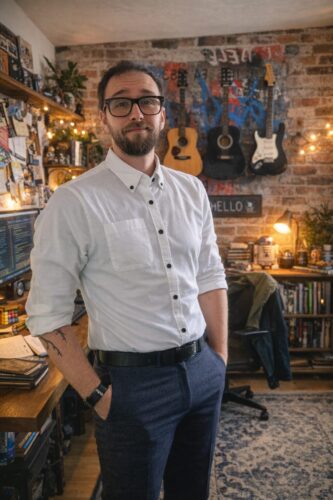
What did you do before you joined the MDS?
“I’m very much a computer scientist by background. I’ve worked in the cyber-physical domain – the intersection of coding, robotics, and physical systems – with a particular focus on data heterogeneity. That meant combining data from many varied sources and formats into single, usable fields for downstream applications.
After a computer science degree, I took a role as Digital Twin Manager at the British Antarctic Survey’s newly formed AI lab. My work there involved combining large volumes of environmental data from various sources to help with navigation of the RRS Sir David Attenborough, the UK’s flagship polar research vessel. After nearly four years at BAS, I began working at the MDS part-time in March, alongside a continuing role as a Senior AI/ML Technology Expert working with perception and sensor data.”
What drew you to the MDS role?
“A lot of it actually comes from my mum. My mum has been very long-term interested in historical things. She was one of the directors of the Framework Knitting Museum in Wigston. She works very closely with the Wigston Historical Society. I think she has traced our family tree back all the way to Adam and Eve and is constantly talking about these things. I’ve grown an interest just by osmosis.”
“Also, I’m very interested in the idea that there is lots and lots of information out there being stored separately by different organisations, and it’s very difficult to get a large overview. The concept of the MDS as a whole seems very simple – why don’t we have one place where we store all the data to make it really easy to access? A lot of people assume that already exists because it’s such a simple idea. We’ve had the technology to do it probably since before I was born, but it never did. Being able to be one of the people that gets to work on these things and bring these concepts into life, to then provide lots of downstream applications — that’s quite an exciting prospect.”
What has surprised you so far?
“Hearing similar frustrations from a lot of different people — not necessarily surprising that people have these frustrations, but surprising that there’s not been much done to actually address them.”
“Also surprising is the vast number of different organisations giving data to the MDS, and how little friction there is in the process of getting data in. That’s really appealing — it really does show that there’s a possibility to get the vast majority of organisations on board and catalogued into one place. It does make the MDS job more difficult, because there’s lots to do on our side to make that process easy and then deliver everything in one place in a format that’s accessible and usable by researchers.”
“One of the first things I did here was trying to map out all the different systems the MDS touches, and there are quite a few. For something that looks so simple on the surface, there’s an incredible amount of different related systems behind the scenes. In computer science, ‘standing on the shoulders of giants’ is apt — a very simple system only exists because there are layers and layers of potentially more complex systems underneath. Hopefully MDS can be the shoulders that other things stand on.”
Do you have ideas for ways to use MDS data?
“One idea I really love is creating virtual collections that are abstract from location — a collection of things around a topic rather than around an organisation. Say you really care about 18th century swords that are less than 12 inches long: you could find where all of them are in the country without going through every single organisation individually, make a virtual collection, and display it online. All those tiny, niche ideas that potentially only a couple of people care about — it gives them the option to find these things. Someone could even plan a tour around it.”
Do you have a favourite museum or museum experience?
Sam mentioned the Imperial War Museum and the Natural History Museum, before coming back to the Framework Knitting Museum in Wigston:
“It’s very, very small — one house, one collection. But going in and being able to pick up the tacit knowledge of all the people associated with these things is inspiring. Having someone explain an object you wouldn’t look at twice if they weren’t there — someone who’s spent years researching it and can tell you the tiniest details and make them sound fantastic just because of the passion they have for it. That’s the great thing about museums: you’ve got the big ones with amazing displays, and then you have the little ones where someone can tell you an amazingly intricate backstory to what seems like just a napkin, and you could be completely enthralled by it, just from people’s passion.”
“Also, it’s haunted — just to throw in some additional fun. They found witch markings on certain beams and posts and have had ghost hunters in every now and then. You go in for framework knitting and then you get told ghost stories as well.”
AI disclosure: we used AI (Copilot, Siri, Claude) to transcribe our conversation and tidy up the text.