
- Title:
- Millar's New Complete & Universal System of Geography
- Object name(s):
- Collection:
- Government Art Collection
- Acquisition note:
- Purchased from Grosvenor Prints, London, October 2004
- Associated concept:
- topography
- Associated concept:
- townscape/cityscape
- Associated concept:
- rowing boat
- Associated concept:
- canoe
- Associated concept:
- oar
- Associated concept:
- seascape/coastal scene
- Associated concept:
- tree
- Associated concept:
- path
- Associated concept:
- shore
- Associated concept:
- house
- Associated concept:
- man
- Associated concept:
- woman
- Associated concept:
- sea
- Associated concept:
- flag (as Subject)
- Associated date:
- published 1782
- Date - association:
- Production
- Date - earliest / single:
- 1782
- Date - latest:
- 1782
- Associated place:
- South America
- Associated place:
- Brazil
- Current location:
- British Embassy
- Location address:
- Brasilia
- Current reproduction location:
- https://gac.collectionsindex.com/api/webimg/O32427/2414.jpg
- Dimension:
- height: 23.00 cm, width: 33.60 cm
- Inscription content:
- below image: [centre] View of S.t SALVADOR, a City of South America. / [right] Sherwin sculp.
- Inscription description:
- Lettering
- Object name:
- Object number:
- 17888
- Object number:
- 00017888
- Object production person:
- Sherwin, John Keyse
- Person's biographical note:
- John Keyse Sherwin was born in Sussex, the son of Francis Sherwin, a labourer. He initially worked as a gardener on William Mitford’s estate near Petworth. In 1769, Mitford sent one of his drawings to the Society of Arts and the work won the silver medal. Sherwin later moved to London, where he studied painting under John Astley and engraving under Bartolozzi. In 1770 he entered the Royal Academy Schools. He set up his own studio in 1774, publishing his first engraving in 1775. During the next ten years he exhibited drawings of historical subjects. He also engraved works by Reynolds, Kauffman, Gainsborough and others. In 1785 he was made Historical Engraver to King George III. However, he died aged just 37 in an alehouse in Westminster.
- Person's birth date:
- 1751
- Person's birth date:
- 1790
- Right type:
- Copyright
- Technique:
- Coloured engraving
- Text:
- Grosvenor Prints, London
- Text reason:
- Object-history-note
- Text:
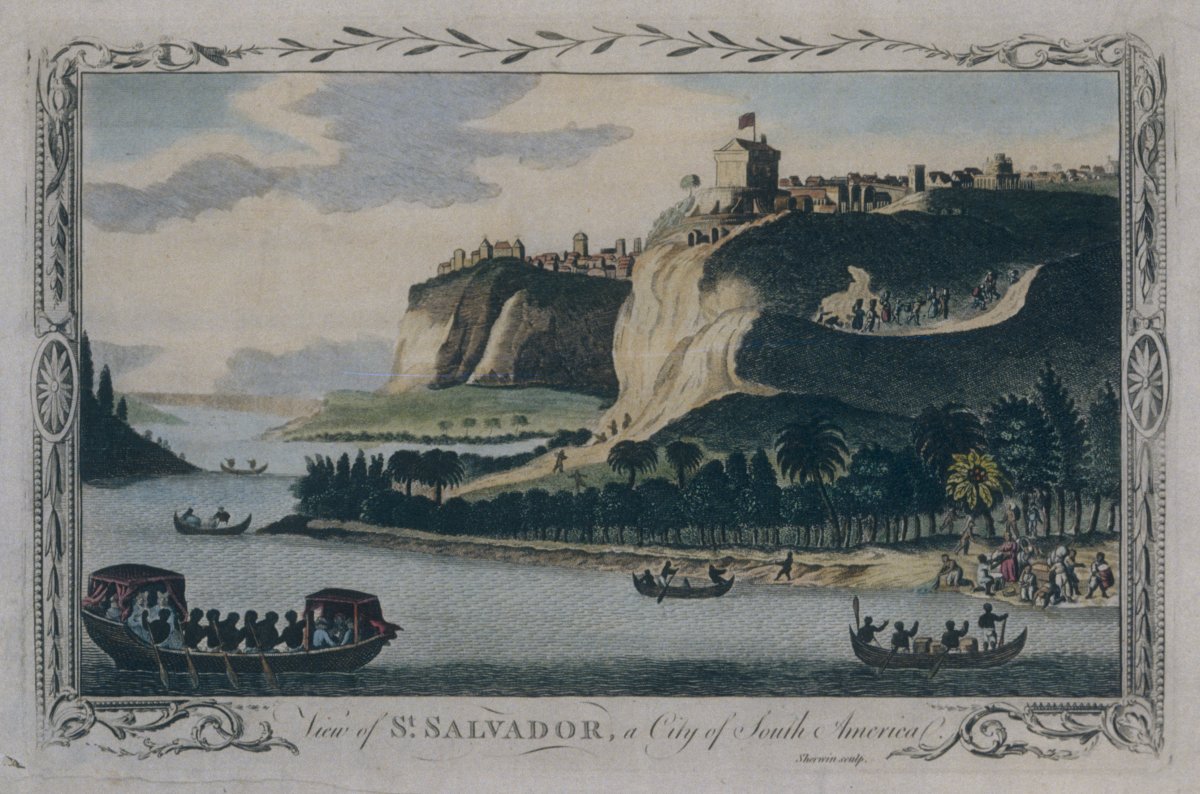
- This coloured engraving of 1782, showing a view of Salvador, was made after a print
that was originally published in George Millar’s ambitiously titled work The New and Universal System of Geography: Being a Complete History and Description of the Whole World. This work aimed to provide the reader with ‘a particular, full, accurate, circumstantial and entertaining Account’ of everything from the geographical features of countries to their histories, and from descriptions of flora and fauna to local customs.
The print of Salvador appears in the relatively small section devoted to Brazil near the end of the publication. As with the other locations presented in this work, the author writes of a number of aspects of Brazil: its history and its terrain, the local populations and occupations. Although the print and publication are dated 1782, almost twenty years after Rio de Janeiro took the place of Salvador as capital of the Portuguese colony of Brazil, Salvador is still referred to as the country’s ‘principle city’ and discussion of Rio is allotted only a small paragraph. Salvador was founded as capital of Brazil in 1549 by Tomé de Sousa, the first governor-general. It was a centre of both the sugar and slave trades and continues to be known for its distinctive Afro-Brazilian culture. Millar refers to it as ‘populous, magnificent, and the most gay and opulent city in all Brazil’. - Text reason:
- Object-label-text
Persistent shareable link for this record: https://museumdata.uk/objects/a5f4c9e3-ed3a-391d-b868-01fbcec37048
Use licence for this record: Open Government Licence
Attribution for this record: https://museumdata.uk/objects/a5f4c9e3-ed3a-391d-b868-01fbcec37048, Government Art Collection, Open Government Licence
Is there a problem with this record? Give feedback.